— A note before you begin —
This guide is written for the private buyer of a professional protection dog. It is not a sales document. It is not an advertisement for K1K9 or the PSSK9™ Program. It is the education document the industry should have written for you thirty years ago, and did not. Read it before you spend the money. Read it before you sign a contract. Read it before you meet a single seller.
If you are reading this page, you have probably already looked at the price tags. You know that a serious protection dog costs somewhere between $35,000 and $250,000, and you have probably wondered why the range is so wide, why the marketing all sounds the same, and why the person selling you a $150,000 dog cannot answer a technical question about the dog you are about to buy.
The reason is simple. The protection-dog market is one of the last major luxury markets in America without an independent standard. There is no Consumer Reports for working dogs. There is no Underwriters Laboratories certification. There is no NADA guide. There is no equivalent of the American Kennel Club for real protection work — because the AKC does not evaluate protection work, and the sport organizations that do (Schutzhund, IPO, Mondio, PSA) evaluate sport, not real-world protection under ambiguous conditions.
Into that vacuum has walked a decade’s worth of confident marketing, celebrity endorsement, staged Instagram video, and a handful of legitimate operators quietly doing the real work while the market gets loud around them.
This guide will not tell you which specific seller to buy from. It will do something more useful: it will teach you the questions to ask, the red flags to walk away from, and the framework to think about what you actually need.
The seller’s job is to sell you a dog. Your job is to protect your household. Those are not the same job.
— Chapter 1 —
The Difference That Nobody Wants to Explain to You
There are two entirely separate disciplines being sold to you under the same label. They look similar on Instagram. They are not similar. The first is sport protection. The second is real-world protection. If you do not understand the difference before you buy, you will pay real-world prices for a sport-trained dog, and you will not know it until the day the dog needs to work.
What Sport Protection Actually Is
Sport protection — Schutzhund, IPO, IGP, Mondio, PSA, French Ring, KNPV, Belgian Ring — is a set of athletic sports developed originally to test working-line breeding stock. They are legitimate sports. They are legitimate tests of certain athletic qualities. They are not real-world protection tests, and their governing bodies do not claim they are.
In every sport protection test, the following is true:
- The decoy is a known figure — the dog knows a suit or sleeve is coming.
- The environment is a known field — not the client’s home, courthouse, school, or vehicle.
- The routines are choreographed — the dog knows the sequence.
- The rules of engagement are published — the dog knows what "counts."
- The dog is being scored on form, not on outcome.
None of this is a criticism of sport. Sport does what sport is designed to do: test athletic breed capacity under standardized conditions. But if you are buying a dog to keep your family safe in your own home — and your home is not a Schutzhund field — then a sport title is telling you almost nothing you need to know.
What Real-World Protection Requires
Real-world protection is the discipline of proofing a dog to perform, or specifically to not perform, under conditions the dog has never seen before, against a threat the dog cannot predict, in an environment the dog does not own, in front of humans the dog must not injure.
It requires:
- Engagement without command — the dog reads the threat itself.
- Disengagement on command — the dog terminates on cue, mid-bite, without hesitation.
- Environmental composure — the dog functions in restaurants, courthouses, airports, hotels, vehicles, boats, elevators.
- Household inhibition — the dog does not engage the mail carrier, the housekeeper, the child’s friend, the guest.
- Ambiguous-decoy proofing — the dog reads intent, not costume.
None of the above is measured in any sport title. Not one. A dog with a IPO3 title has demonstrated no proof of any of it. The dog may or may not have it; the title is silent on the question.
A sport title is proof of what the dog can do on the field. It is not proof of what the dog will do in your home. If a seller cannot articulate that distinction, walk away.
— Chapter 2 —
The Ten Lies You Will Be Told
The following ten statements are the most common misdirections in the protection-dog market. They are not all outright lies. Some are half-truths, some are legacy vocabulary, and some are deliberate manipulations. All of them will cost you money if you take them at face value.
Lie #1: "Our dogs are titled, so they’re proven."
The reality: A title proves the dog can perform sport routines on a sport field. It proves nothing about real-world protection. Ask instead: what real-world scenarios has this specific dog been proofed in?
Lie #2: "Our dogs are police-quality."
The reality: "Police-quality" is a marketing phrase with no institutional meaning. There is no national standard for what "police-quality" means and no national body that certifies it. Ask instead: what specific agency has certified this dog, on what specific standard, on what specific date?
Lie #3: "You need a Belgian Malinois for real protection work."
The reality: You need the dog whose temperament, size, and drive threshold match your household and use case. For most private families, a Malinois is exactly the wrong dog — too much drive, too much energy, too much wear-and-tear on the household. Ask instead: what temperament profile is right for my actual life?
Lie #4: "This dog has X thousand hours of training."
The reality: "Training hours" is an unauditable claim. What matters is documented sessions, witnessed proofs, and named scenarios. Ask instead: can I see the training log with dates, scenarios, and outcomes?
Lie #5: "Our head trainer is a former Navy SEAL / Delta / Green Beret / Ranger."
The reality: Special operations background is impressive, but it is not by itself a K9 credential. A special-operations veteran who has not personally spent thousands of hours on dog training is a marketing hire, not a K9 authority. Ask instead: what is this person’s specific K9 background, independent of their military service?
Lie #6: "Our dogs come with a lifetime guarantee."
The reality: Every guarantee has fine print. Read it. Most "lifetime guarantees" cover replacement only, with restocking fees, transportation costs, and a laundry list of exclusions that make the guarantee close to worthless. Ask instead: what specifically is guaranteed, for how long, and under what conditions?
Lie #7: "Handler training is included."
The reality: "Included" often means a two-day handoff, a video series, and a phone number to call. That is not handler training. Real handler training is a documented, weeks-long course with witnessed proofs. Ask instead: what is the specific curriculum, how long is it, and what happens if I fail the assessment?
Lie #8: "This dog is fully socialized."
The reality: Socialization is a spectrum, not a checkbox. A dog is socialized to what it has been documentably exposed to. A dog raised in a rural kennel is not socialized to urban environments, no matter what the ad copy says. Ask instead: can I see the documented socialization log?
Lie #9: "The dog’s bite is X pounds per square inch."
The reality: Bite-force marketing is a distraction. What matters is bite quality — the calm, full, held grip, the clean disengagement, and the target selection. A dog with a "1,200 PSI bite" who cannot disengage on cue is a liability, not a protector. Ask instead: show me the disengagement work on video, in an environment the dog has not been in before.
Lie #10: "You’re getting a dog from proven lines."
The reality: Lineage matters, but lineage without individual proof is genetics without evidence. The individual dog is what you are buying. Ask instead: show me what this dog, not this bloodline, has done.
— Chapter 3 —
The Questions You Should Ask Every Seller
These are the questions the industry does not want you to ask because they cannot be answered with marketing language. If a seller cannot answer them cleanly and specifically, you have your answer about the seller.
About the Individual Dog
- Who bred this dog? Can I contact the breeder directly?
- What specific scenarios has this dog been proofed in? Can I see the log?
- What is this dog’s recorded disengagement time on command? On video?
- What environments has this dog worked in? (Not "trained in" — worked in.)
- What is this dog’s known temperament weakness? (Every dog has one. A seller who says "none" is lying or does not know the dog.)
- What medical clearances does this dog carry, from which vet, dated when?
- Has this dog ever bitten anyone in a real incident? What was the outcome?
About the Seller
- How long has your program been in continuous operation?
- How many dogs have you placed with private clients? Can I contact three of them?
- What credential do you hold, personally, on real-world protection work?
- What is your policy if the dog does not perform as sold?
- What is your insurance coverage on placed dogs?
- Have you ever had a placed dog cause an incident that resulted in litigation? What was the outcome?
About Handler Training
- What is the specific written curriculum?
- How many days, hours, in-person?
- What is the assessment at the end? Who witnesses it?
- What happens if I fail the assessment?
- What is the annual refresher requirement?
- Can I train at a facility other than yours?
About the Contract
- Who owns the dog on paper — me, or you, or a joint ownership?
- What are the specific conditions under which the dog can be repossessed?
- What is the return policy in the first 30 / 60 / 90 days?
- What are my liability responsibilities?
- What ongoing obligations do I have to your program?
— Chapter 4 —
The Red Flags That Should End the Conversation
If any of the following appears in your interaction with a seller, the conversation is over. You are not being rude; you are exercising judgment.
Red Flag #1
The seller cannot articulate the difference between sport and real-world protection. If they cannot name the difference, they cannot deliver either one at the level you are paying for.
Red Flag #2
The seller refuses to let you visit the training facility unannounced. Legitimate programs welcome oversight. Programs that only allow curated visits are hiding something.
Red Flag #3
The seller uses celebrity endorsements as proof of quality. Celebrities do not evaluate dogs. They pay other people to evaluate dogs. A wall of famous names tells you about marketing spend, not about capability.
Red Flag #4
The seller demands a large deposit before you meet the specific dog. Deposits are normal; sight-unseen commitments are not.
Red Flag #5
The seller pressures you to buy on the visit. A dog is a fifteen-year decision. Anyone who cannot let you take a week to decide does not respect the decision.
Red Flag #6
The seller cannot produce three private-client references you can contact directly. If you cannot talk to real households who have lived with real dogs from this program, you are the reference case.
Red Flag #7
The seller’s written contract contains a mandatory-arbitration clause and no return provision. Read the contract line by line. If the fine print protects only the seller, the deal protects only the seller.
Red Flag #8
The seller offers to sell you a "premium" version of the same dog for more money. That is a sales tactic, not a training reality. A dog is either proofed to a standard or it is not.
— Chapter 5 —
What a Real Protection Dog Should Actually Do
This is the shortlist. A real, functional, private-side protection dog should demonstrate every one of the following, on video, in environments the dog has not seen before, in front of you, before you write the check.
- Enter a novel environment and remain calm on-lead within 3 minutes.
- Ignore a friendly stranger who approaches at a normal walking pace and offers a hand.
- Engage on command against a decoy in a full suit.
- Engage without command against a decoy who signals real aggressive intent toward the handler.
- Disengage on a single command mid-bite, and return to the handler within 5 seconds.
- Perform a controlled recall from a full run, ignoring the decoy.
- Load into a vehicle, ride calmly, exit on command, and return to a working state within 60 seconds.
- Hold a "place" command for 20+ minutes while the handler moves out of sight.
- Ignore food, thrown toys, and secondary decoys while working.
- Wear and tolerate a muzzle without loss of confidence.
Anything less than the above list, from a dog you are being asked to pay $35,000 or more for, is under-delivered. Anything more — and there is much more that a top-tier dog will do — is icing.
— Chapter 6 —
The Math of What This Costs (Really)
The purchase price of the dog is often the smallest number in the total cost of ownership. Buyers who focus only on the sticker price get surprised in year one. The full cost includes:
- Purchase price — $35K to $250K depending on the program and the dog.
- Handler training — $5K to $25K if not included; more if it is real.
- Ongoing training — $500 to $2,000 per month for monthly reinforcement work.
- Annual refresher — $2K to $10K for a proper witnessed reassessment.
- Insurance — specialty rider on the household policy, often $500 to $2,000 per year.
- Veterinary — working-line dogs require more care, not less; budget $3K to $8K per year.
- Equipment — leads, muzzles, kennels, transport, medical kits; $2K to $5K in year one.
- Legal — a working-dog rider on your umbrella policy, plus documented waivers.
Total cost of ownership over ten years, for a real dog with a real training program, is realistically two to three times the purchase price. Any seller who tells you otherwise is either uninformed or misleading.
— Chapter 7 —
The Contract Clauses That Should Give You Pause
Read the contract. Have a lawyer read the contract. Every one of the following clauses should trigger a hard conversation before you sign.
- Joint-ownership language that gives the seller a permanent claim to the dog.
- Mandatory-training clauses that lock you into ongoing services at seller-set rates.
- Right-of-first-refusal clauses on future placements.
- Non-compete language that restricts you from working with other trainers.
- Confidentiality clauses that prevent you from publicly reviewing the seller.
- Repossession clauses triggered by "handler negligence" defined only by the seller.
- No-return clauses beyond an unreasonably short window.
- Waiver of all warranties — express, implied, and statutory.
Any one of these on its own is a negotiation point. Two or more of them together is a walk-away.
— Chapter 8 —
Sport vs. PSSK9™ — A Direct Comparison
To close the education section of this guide, here is the direct side-by-side you will not find on any seller’s website.
| Dimension |
Sport Protection |
PSSK9™ (Real-World) |
| Decoy | Known figure, signals fight | Ambiguous, may not signal |
| Environment | Sport field, known layout | Novel: home, courthouse, hotel, vehicle |
| Engagement | On command per routine | Independent read of threat |
| Disengagement | On judge cue | On single handler word, mid-bite |
| Household inhibition | Not tested | Central to certification |
| Third-party discrimination | Not tested | Explicitly proofed |
| Scoring | Form and technique | Outcome under ambiguity |
| Purpose | Test breeding stock athleticism | Protect a specific household |
— Chapter 9 —
About K1K9 and the PSSK9™ Program
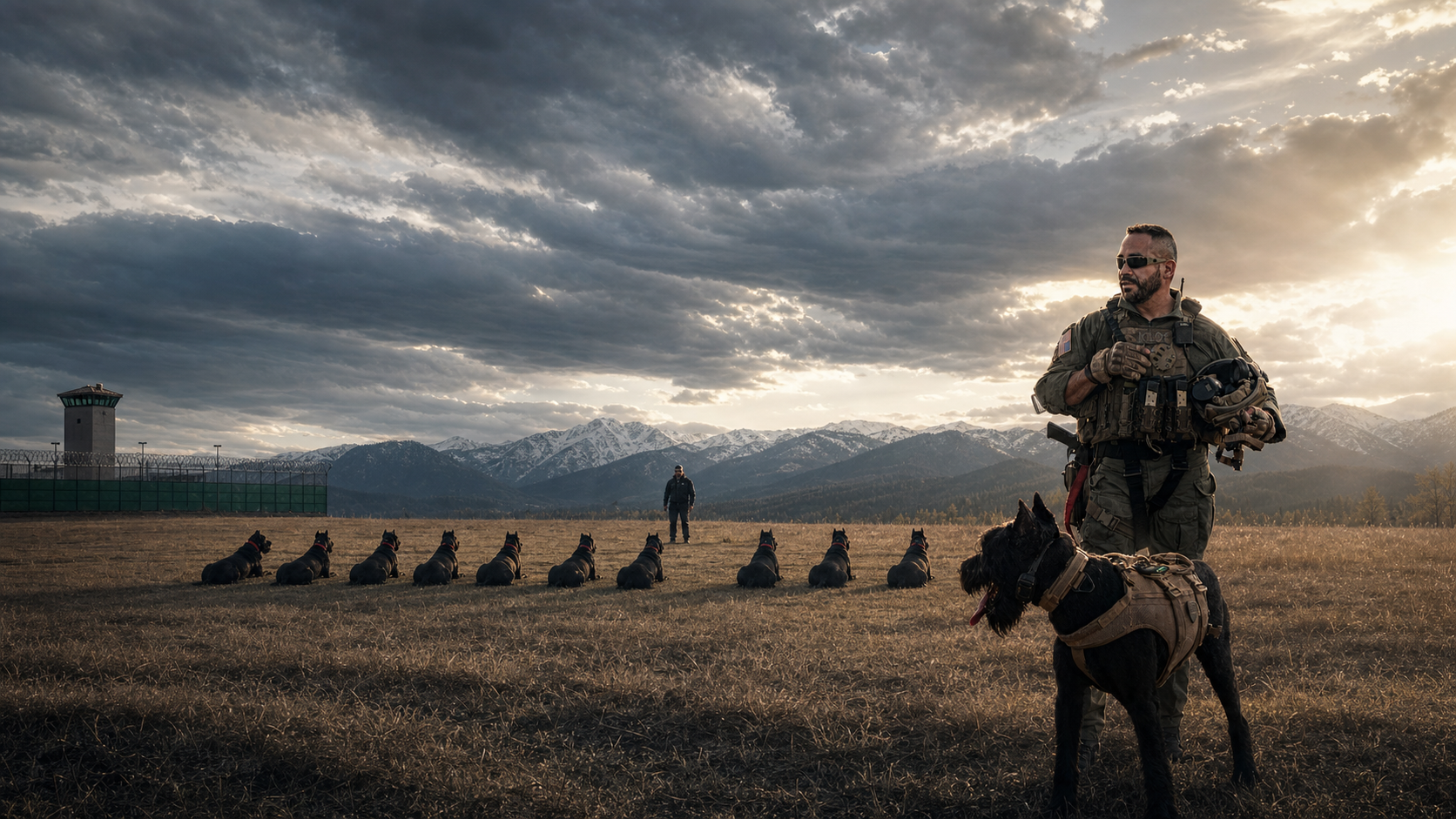
This guide was written by K1K9. That is the disclosure it starts and ends with. K1K9 is a small, doctrine-driven program in Montana that has placed working Giant Schnauzers with private households, corrections agencies, and government principals for a decade. It is not a large operation. It does not want to be.
K1K9 wrote the PSSK9™ standard because the industry K1K9 came out of did not have one. The standard is a public document. Any operator who wants to work at the level the standard names is welcome to. Any operator who does not want to is welcome to keep doing what they are doing.
You are not required to buy from K1K9 to use this guide. You are not required to buy any PSSK9™ credentialed dog. You are not required to do anything except read the questions above and think about them honestly before you spend the money.
The buyer’s protection is more important than the seller’s convenience. If this guide costs the industry sales it should not have made, it has done its job.
— Chapter 10 —
What To Do Next
Whatever seller you are working with, before you sign:
- Print the questions in Chapter 3. Ask every one of them. In writing if possible.
- Print the red flags in Chapter 4. Compare against your interaction so far.
- Print the demonstration list in Chapter 5. Ask to see it, in an environment the dog has not been in.
- Print the ownership cost list in Chapter 6. Update your household budget.
- Print the contract clauses in Chapter 7. Give the list to your lawyer.
If any of the above disqualifies the seller you are considering — that is the guide doing its job. If none of it disqualifies them — you now have documented reason to move forward with confidence.
— Chapter 11 —
A Final Word to the Buyer
You are not being paranoid to ask these questions. You are being responsible. You are not being rude to a seller who cannot answer them — you are being clear about the standard your household requires.
The protection-dog industry has been allowed to sell you emotion, aesthetics, and celebrity endorsement for too long. Your household is not an emotion. Your family is not aesthetics. Your safety is not a celebrity endorsement. If a dog is going to live in your home for the next twelve to fifteen years, and if that dog is going to be trusted to make split-second decisions about the safety of the humans in that home, then the standard that produced the dog matters more than the packaging around the sale.
Ask the questions. Walk from the red flags. Buy from the standard.
— Continue —
The PSSK9™ Program
The full doctrine, credential ladder, and facility standard the guide references.
Open the PSSK9™ Program →