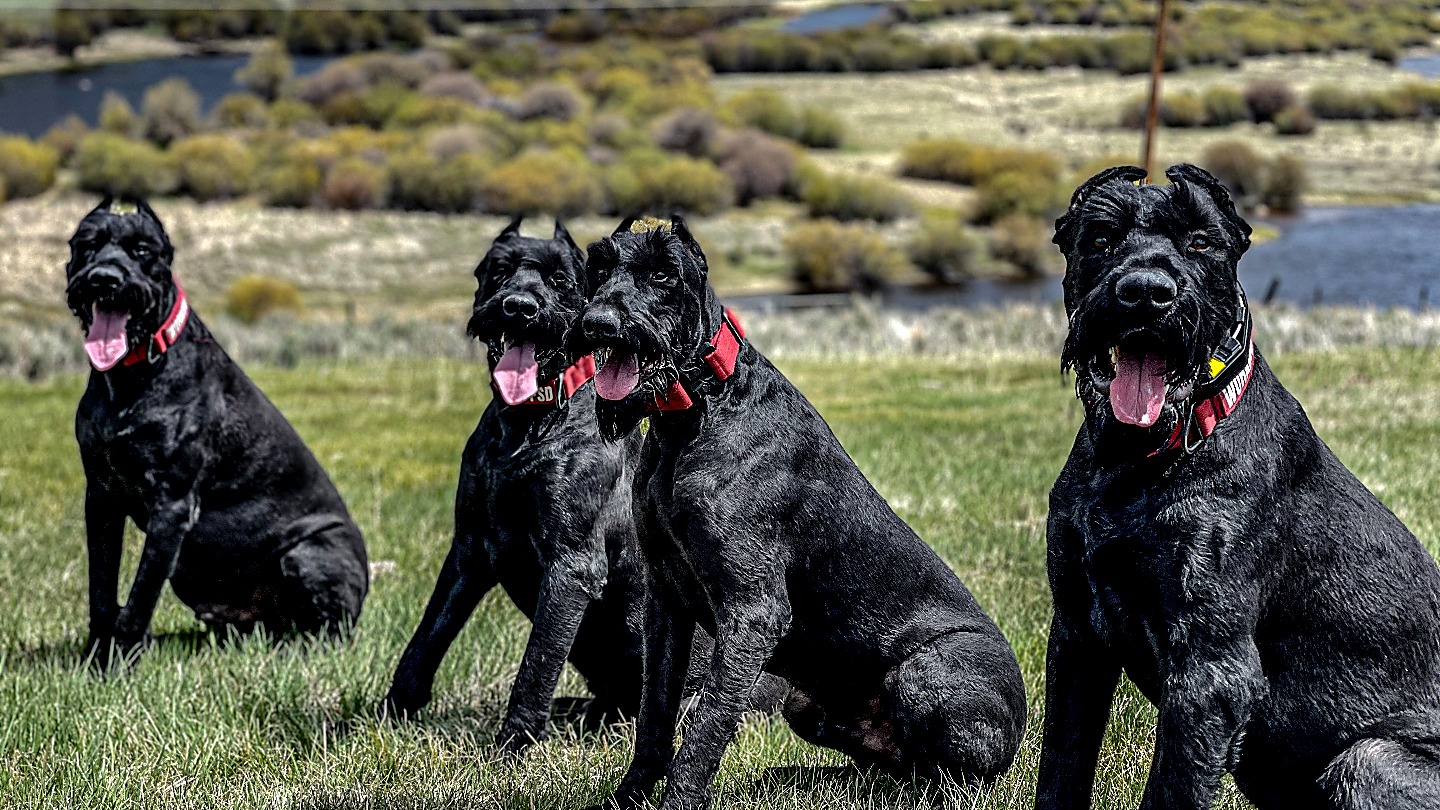
One breed. Chosen on purpose. Kept because it kept working.
One BREED. One STANDARD. One PROVEN PLATFORM.
We run High-Performance Giant Schnauzers, and only Giant Schnauzers. The decision was made on what actually held up under real consequence — not on breed reputation, not on what sells, and not on what the internet expects a serious dog to look like. A dog that cannot live inside your home is not a special services dog. It is a kennel dog with a job title.
Hard, wiry, very dense — a soft undercoat under a harsh outer coat that sheds far less into a home than a smooth-coated working breed. For a dog that lives inside your residence, travels in your vehicle, and works in occupied buildings, that matters more than most people expect.
We will be straight with you: no dog is truly hypoallergenic. Every dog produces allergens in saliva and skin regardless of coat type. What is true is that this coat sheds far less than most working breeds and is frequently tolerated by people who react badly to other dogs.
If someone in the household has a diagnosed dog allergy or asthma, spend time around the breed before you commit, and involve your physician. We will not sell you a dog on a promise about your family’s health.
The written standard for the breed asks for spirit and alertness combined with intelligence and reliability, and describes the dog as composed, watchful, courageous, easily trained, deeply loyal to family, playful, amiable in repose, and a commanding figure when aroused.
That is not marketing language we invented. It is the breed’s own standard, and it happens to describe exactly what this work requires.
Males stand roughly 25½ to 27½ inches at the withers and females 23½ to 25½, with the mediums preferred. The standard itself notes that dogs which are too small lack power and dogs which are too large lack agility and maneuverability.
In a confined corridor, a stairwell, a vehicle interior, or a crowded room, that middle band is the whole point.
Robust, strongly built, nearly square, active and well muscled, with a dense weather-resistant coat — a combination the standard describes as producing one of the most useful, powerful, and enduring working breeds.
Endurance is the word that matters. Power that expires after ninety seconds is not power we can use.
We use European lineage developed for serious working ability rather than for the show ring or the pet market. Selection is on demonstrated capacity in the line — nerve, recovery, biddability, drive that can be switched off — supported by health screening rather than assumed from a pedigree.
The breed came out of southern Germany as a multipurpose farm dog: guarding the farmer’s property and driving livestock to market. Two jobs that require completely different states of mind in the same animal, on the same day.
By the turn of the twentieth century it was the watchdog of factories, breweries, butcher shops, and stockyards — working around strangers, noise, movement, and confined industrial space rather than on open ground. Largely unknown outside Bavaria until it became widely used in service through both world wars, it continues in police service today.
A breed developed to hold property against strangers, move stock, and work industrial interiors was never a novelty choice for demanding professional work. It was the obvious one.
The pre-1900 origins are thin and partly contradictory, and we are not going to dress that up. What is on the record is that by the time anybody wrote the breed down, it was already expected to move livestock and hold a stranger. Dates below come from the Fédération Cynologique Internationale standard, the American Kennel Club, and the Giant Schnauzer Club of America.
History is not decoration on a sales page. Every one of these traits was selected for by people who needed the dog to work, and every one of them is still the reason we run this breed and no other.
One honest caveat: the breed on the record and the average Giant Schnauzer available today are not the same animal. A century of selecting for appearance rather than function has put distance between them. That gap is exactly why we do not buy a dog because it is registered, and why lineage and proven capacity in the dog decide what we will work.
The coat that keeps hair out of your house has to be maintained, and it is work: regular stripping or clipping, beard and eyebrows kept clean, feet and ears checked. Neglect it and you get matting, skin problems, and a dog that is uncomfortable.
The mind that makes the breed trainable is the same mind that will find its own job if you do not give it one, and you will not like the job it picks.
A Giant Schnauzer with nothing to do is not a calm dog. It is an unemployed one.
Coat care is taught as part of client onboarding.
Anyone who tells you their line has no health considerations is either uninformed or lying to you. The Giant Schnauzer is a large working breed with a life expectancy of roughly twelve years, and it has known predispositions. We screen for them and we tell owners what to watch for, because a client who knows the list catches things early.
Health information here is general breed background for prospective owners and is not veterinary advice. Screening results for a specific K1K9™ are provided with that dog.
A well-bred Giant Schnauzer is not a K1K9. It is the raw material one is developed from. The K1K9 you are considering was developed inside the most controlled and least forgiving working K9 environment in the United States. That is where the K1K9 line is validated before it is ever tailored for civilian placement. It is not a marketing lineage. It is why a K1K9 does what it does when the moment is real.