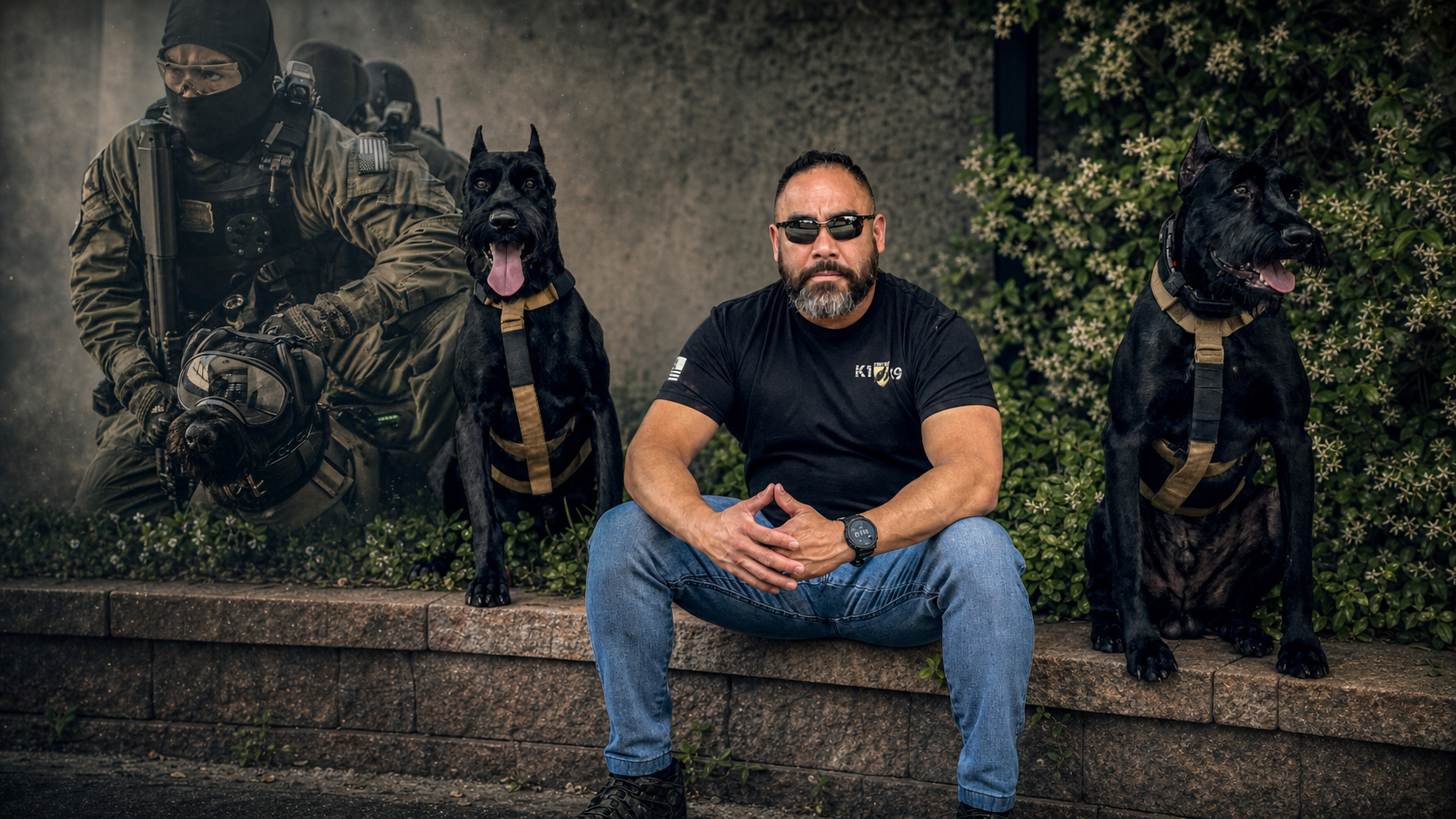
Montana. Senior Handler of K1K9™. Federally trained. Actively handling. Every K9 that places is presented to the household by him personally.
STL Joseph Garcia and the K1K9 Giant Schnauzers
Six-page exclusive Q&A on corrections K9 doctrine, Giant Schnauzer team methodology, and twenty-five years of correctional response operations. By Mike Detty. Photography: K1K9.
Read the Full Article“If you see me on the news we didn’t do our job.”
— STL Joseph Garcia, Tactical Life Magazine, Aug./Sept. 2020A short film series from KILO1. Recorded in Montana. Nothing rehearsed. Nothing staged.
Thirty-plus years across corrections special operations, federal protective-service training, and working-K9 doctrine. Programs designed. Kinetic engagements survived. Handlers trained across multiple state agencies.
K1K9 is the private continuation of that work — delivered by the operator who built it, still on the ground, still running the dogs.
The K1K9 story is a very different one.
It is not the story of a military veteran who worked with detection dogs. It is not the story of a special-forces trainer who prepared dogs for an external mission. It is the story of a man who spent his career inside law enforcement's least understood corner — the corrections special operations community. The less-than-half-of-one-percent.
I designed programs for the industry. I traveled. I worked more real engagements inside prison walls than the public record will ever reflect. When the next phase came, I built the corrections special operations K9 program that today has taken this unit and these dogs across multiple continents — presenting to other governments, law enforcement agencies, and canine special operations units.
There was no path for us before this. Only traditional police sport and military-style training. Neither was adaptable to what actually happens inside prison walls.
The difference is real engagement. Our K9s face more of it than traditional police or military K9s because a prison operates around the clock with no reset. The environment is populated — continuously — by individuals whose full-time occupation is finding ways to defeat the staff, including the K9s. That is the environment. It is the one place where the science of counter-aggression toward a working K9 is written in real time.
So I studied it. I studied the video. I studied exactly how a K9 gets hurt and exactly how the interaction resolves when the instinct is unleashed. I took the intelligence I gathered from what I observed and turned it back against the problem.
Alongside some of the most talented canine specialists I have ever worked with, I built what I believe is the most comprehensive, field-proven engagement program for corrections K9s in existence.
That is where our story begins. In the engagements, we learned. In the aftermath, we translated it — first to our own teams, and now to a small number of private principals who want a K9 whose discipline was built in the one environment where the science was written in real time.
I have lived kinetic engagements. Not simulated them, not taught them from a manual — lived them. In multi-state corrections special operations, and across more than fifteen countries and a large number of facilities worldwide, I have worked engagements the industry has almost no public vocabulary for.
“That experience is the difference between a program written by an instructor and a program written by an operator.” — Joseph Garcia · Senior Handler · KILO1™
It is why K1K9 exists as it does.
I am an active handler. Not a former handler. Not an emeritus figure who signs off on other people's work. I still run the K9s. I still stand the details — corrections and private — on multiple continents. I still work the ground where the standard is set.
When you speak to K1K9, you speak to the operator, not to a spokesperson.
I am trained through FLETC — the Federal Law Enforcement Training Centers, U.S. Department of Homeland Security. FLETC is where top government personal-security-detail personnel are trained. It is the same training authority that prepares the protective operators the public associates with the highest levels of federal service.
That training informs how a K1K9 reads a household, a movement, and a threat — not as a dog trained in isolation, but as a working element inside a protective-detail discipline.
Before K1K9, I served as a corrections tactical operator and instructor across multiple state Departments of Corrections. That environment is where consequences do not wait for a scenario to reset. It is where a dog's decision under load becomes a real decision, not a training decision.
Since 2009 I have handled three High-Performance Giant Schnauzers across hundreds of real-world interdiction engagements — the ground the PSSD program was built on.
There is a difference between a trainer and an operator. An instructor teaches what the manual says. A field-experienced operator teaches what happens when the manual meets reality. Both are needed. But when the household is real and the threat is real, you want the second one on the ground.
K1K9 is designed, run, and delivered by an operator handler — not a trainer. That is the doctrine, and that is the difference.
“I take pride in not being called a trainer. There was a time when the title trainer was earned and respected. Today anyone can hang the shingle — take an online course, buy a dog, train it themselves, and call themselves a trainer. I refuse that title. Not because it isn't important, but because I respect what it used to mean too much to accept what it has become.” — Joseph Garcia · Senior Handler · KILO1
I am a handler with experience, and I am a mentor for my K1K9s. The trainers are specialists I bring in for specific skill sets. They arrive, impart the skill, and leave. I am the constant across every K1K9's working life.
I have zero paper qualifications from a trainer certification course. Zero. That is not an oversight. It is a decision.
Those courses are education. Education produces a piece of paper. What my K1K9s need is not education. What they need is real experience in kinetic environments, and mentorship through every engagement and every adjustment. Kinetic environments are everything a K9 was not taught in school. School cannot prepare a K1K9 for unpredictable human behavior under real consequence. Only mentorship through the experience itself can.
I mentor my K1K9 through every experience and every adjustment. I work with specialist trainers on specific skill sets when a specific skill needs to be developed.
“The Formula 1 driver does not write the engine software. He drives the car to the edge, reports what broke, and hands the review to the crew. That is the relationship I have with the specialists I bring in. The specialists rotate. I do not.” — Joseph Garcia · Senior Handler · KILO1
Every K1K9 is mentored personally from seven or eight weeks old — through evaluation, through the pipeline, through placement into the household, and through the working life that follows. There is no phase where a K1K9 is handed off to a scaled program. There is no scaled program. There is only me and the specialist crew I bring in for specific skill sets.
If I cannot mentor every K1K9 that comes through this program, we have too many dogs. Mentorship is the product. Mentorship cannot scale. That is not a limitation. That is the standard.
Any provider who tells you they have mentored hundreds or thousands of dogs personally is telling you something that is not possible. Mentorship at that scale does not exist. What exists at that scale is delegation, and what gets delegated at scale is quality.
K1K9 operators go kinetic monthly. This is not past experience. This is current work. I am not a retired handler cashing in on a career. I am not a former operator selling stories from ten or fifteen years ago. Most providers in this industry are ten-plus years removed from active engagement. They can embellish what they once did. I go monthly kinetic.
Next deployment: East Coast, next week. The month after that, somewhere else. That cadence has not changed since 2009 and will not change while I am the Senior Handler on this program.
Every doctrine paper on this site is written from current data, not archived memory. The K1K9 a household receives is built inside that active-deployment data set.
K1K9 K9s are corrections-origin working dogs. Corrections operates under a different framework than street law-enforcement — different rules of engagement, different environments, different failure modes. Police-K9 certification is written for the street. It is not written for us.
That is why we built the CSO K9 Program certification — the standard our K9s actually operate under. Every K1K9 carries this certification. It is the credential that reflects what the dog is trained to do and where the dog is trained to do it.
The Senior Handler built both the training and the certification. Both remain on the ground.
The Professional Special Services Dogs (PSSD) program is the framework I designed for High-Performance private-family placements. It is not a rebrand of an existing curriculum. It is a new discipline — built from the ground up on real engagement experience, federal protective-service training, and a decade of corrections-special-operations reality.
It is the reason the placements work.
Placement is where most programs end. It is where K1K9 begins the working relationship. When the household requires it, I deploy with the K9 — personally, actively, across multiple continents — as the Senior Handler and operator handler on detail.
Not a contractor. Not a former handler on standby. The same operator who wrote the doctrine, presented the K9, and knows the household.
That continuity is the doctrine in the field.
For principals who require it, K1K9 provides more than a placement. I lead the Protective Services Detail on active client engagements — with vetted contractors operating under my command and K1K9 attachments integrated as a working element of the detail, not a separate function.
Not a handler attached to another team. Not a K9 vendor observing a detail.
The Senior Handler, the K1K9, and the standard, on the ground, in one operational element.
“The person on the other end of the phone is the person who built the program.”
Joseph Garcia · Senior Handler · K1K9 · Call Sign KILO1 · Montana
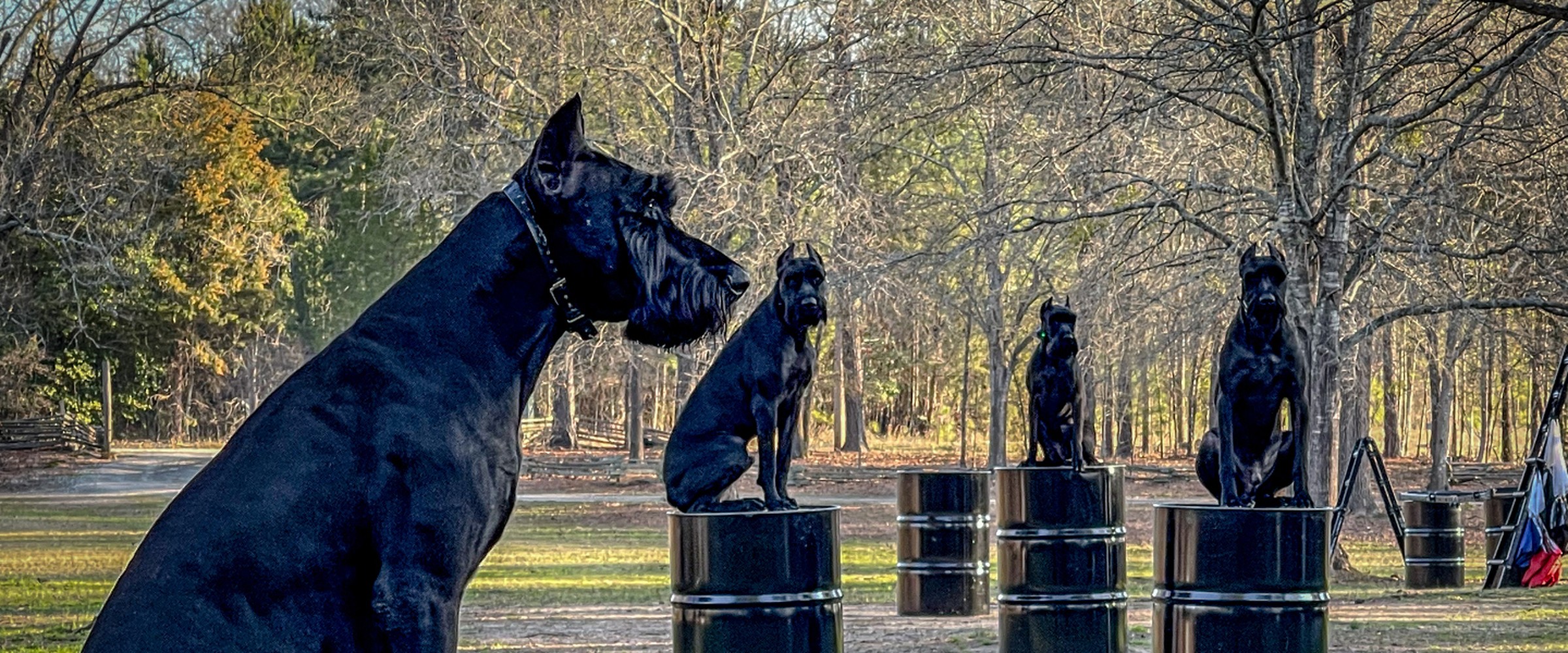
A K1K9 holds the place because holding the place is the standard, not because the handler is watching. Every K9 on the ground earns that discipline through the same doctrine, in the same environment, under the same eye. There is no shortcut. There is no second version.
Marketing does not protect a household. Doctrine does. Training does. The right K9, in the right hands, does.
The dogs the world sees on our public page are the dogs the world will ever see. The dogs that place with households do not appear here — and will not.
You will speak to the person who built the program, or you will not speak to K1K9 at all. That is the doctrine, and it is the difference.