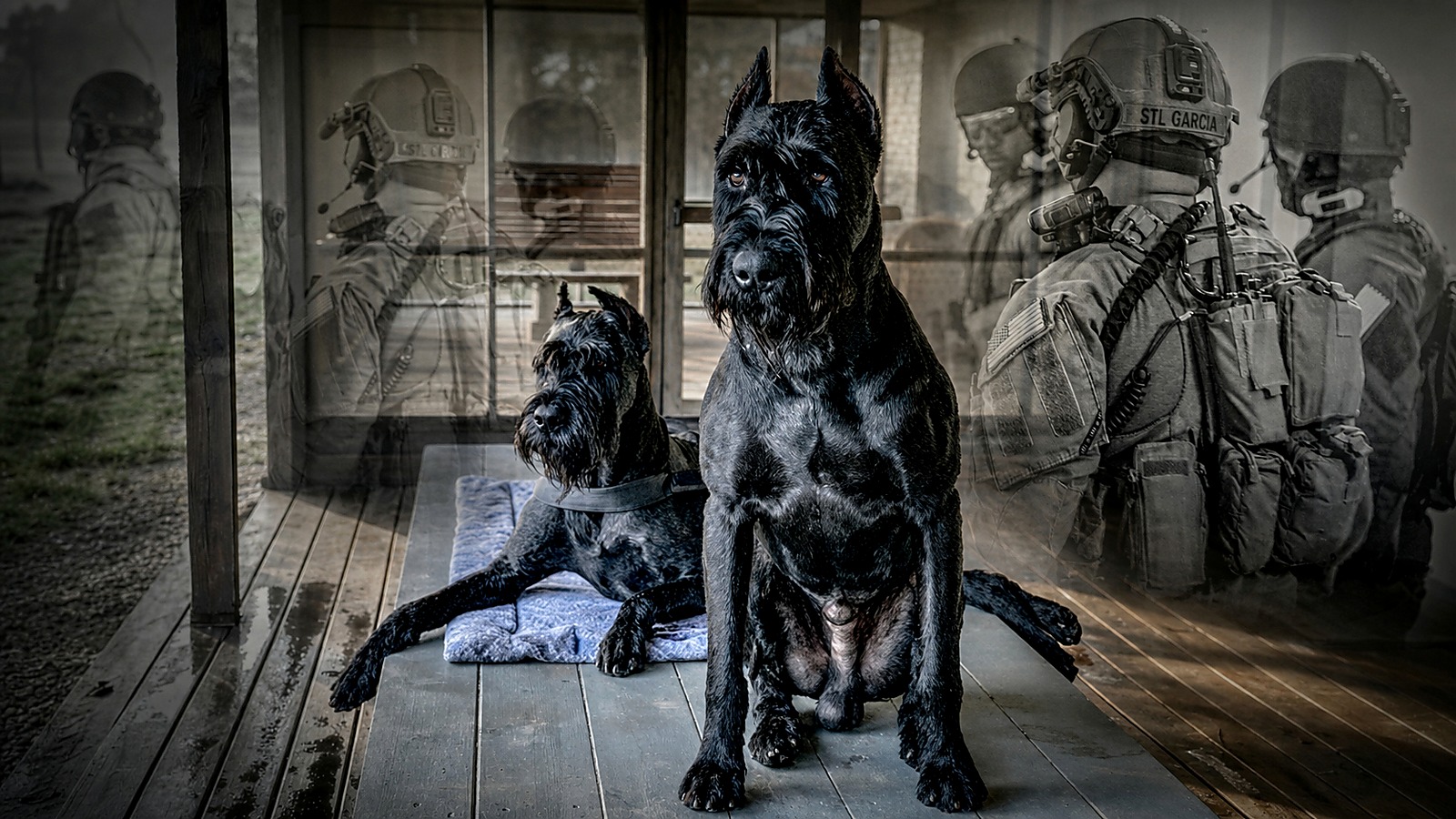
Access is earned. Standards are non-negotiable. The K1K9™ comes first.
Access is EARNED. Standards are NON-NEGOTIABLE. The K1K9 comes FIRST.
Inside a prison, the canine that wins a kinetic engagement is the one that makes the least mistakes. That is who wins. That is why we do not calibrate our dogs in the traditional sense — we calibrate them for the environment where the fight is fast, violent, and unforgiving.
Joseph Garcia · KILO1™
The OPERA Matrix
Every canine that enters the K1K9 system moves through a pipeline. The pipeline begins with the foundation, and after Phase I it splits — because government personal security detail requires one path, and civilian PSSD requires another.
Every client has different specifications. The foundation is shared. Everything above it is customized, phase by phase, to the specification the client defined during intake — and to what we heard them say, correctly, when they said it.
Don’t be fooled by the marketing that says a dog is worth $90,000 or $120,000.
What is the reason for the jump in price? Almost never the time actually put into the canine. That is the smoke and mirrors game the industry runs, and it is one we will not play.
Our clients register, sign up, and go through the entire matrix — from the interview forward — because that is the only way to hear a client correctly and deliver against what they actually asked for.
We do not offer generic instruction, and we do not sell finished dogs on a schedule. What we deliver is a protected system built out of years of developing Giant Schnauzers that had to perform under real pressure rather than in front of an audience.
If you are looking for a weekend certificate, a shortcut to a finished dog, or a seminar that hands you someone else’s system in two days, you will not find it here, and we will tell you that on the first call.
A trainer teaches a drill. A coach develops the handler.
We would rather turn away a paying participant than hand the system to someone who will misapply it and then attach our name to the result.
Every canine in the program is placed into a group, and every group is handled by a team. A team is three to four canine specialists, each with a different skill set, each responsible for teaching the canine the specific skills required for that phase of the pipeline.
Specialists are brought in, work in their lane of expertise, then step out. We do not use the jack-of-all-trades model — one trainer doing all the work, propped up by assistants who have no specialty of their own and are simply learning the trade at the expense of the dog.
We cannot afford to have mistakes imprinted into our canines. Multiple specialists across multiple phases is how we protect consistency, hold accountability, and validate that the work is real — so a dog moves cleanly from skill block to skill block instead of collecting a single trainer’s blind spots.
Operational security is central to how we operate — and it applies at every level of client, from civilian PSSD to government PSD to special-operations taskings.
Specialists are brought in for a specific skill set over a defined period — six weeks, eight weeks, twelve weeks — and are given exactly the picture they need to teach that skill to a high standard. Once their block is complete, the specialist returns to their home base or unit. The full capability picture of any given canine is not known to any member of the team.
We hold the security of our clients, the confidentiality of their engagement, and what their canine ultimately knows at the highest OPSEC level we are capable of.
Structure, sequencing, and advanced application are not published, not sold as a course, and not casually shared. What you will find on this website is the philosophy and the standard, not the system.
Every aspect of the canine’s training and every part of the program is compartmentalized for one reason: to hold continuity, hold OPSEC, and enforce the discipline that makes the finished product real.
This program was built so that not one person knows the entire system. It takes a team to put a dog together. And it takes a handler to beta-test that dog and push it to the highest level of performance on demand.
Compartmentalization costs us reach, and it costs us sales. It is the reason the program still holds its shape after more than fifteen years.
Born behind the razor’s edge
Our decoy development did not come from a sport rulebook and it did not come from the sporting industry. Its foundation was built behind the razor’s edge — studying inmate behavior, mimicking it, and pressure-testing it against working canines since 2009.
The decoys we select are drawn from the special-operations community and from government service. They are taught techniques and tactics that do not exist in the sport world, and they are trained to do one thing the sport world will not train them to do — fight the dog. Not harass it. Not scream at it. Not test how long a dog will hold a single grip under pain. Fight it — mentally, physically, tactically.
The industry decoys today are calibrated for a rulebook. Ours are calibrated for a fight.
Everything the decoy wears and everything the decoy carries is developed in-house or built to specification by a custom house working under contract to us. Proprietary leathers. Proprietary internal construction. Proprietary technology inside the equipment that lets us take a clean, honest reading of what is happening the moment the kinetic engagement begins between the decoy and the canine.
The standard sport decoy operating inside a PSA, IGP, KNVP, or ring-sport matrix has a place in traditional canine protection. For us, that model would miscalibrate the dog from an operational perspective. Screams and harassment don’t build the picture we need. A one-dimensional grip under pressure isn’t the picture either.
What we build instead — and what we hold inside the program — is a decoy trained to the highest standard of safety and taught to be what we call a canine-combative, high-simulation canine fighter. That is the ceiling most of the industry will never see, and it is the floor of what an operational K1K9 is tested against.
During a specific phase of development, a K1K9 canine will fight more than a dozen decoys in a single week.
We do not have our canines spend excessive time with any one decoy. We make an incredible investment in bringing as many qualified kinetic-engagement canine specialists as possible into the program to fight our dogs. That is what gives our dogs the upper hand in understanding human behavior and instinctive response.
The traditional canine-protection world uses the same decoy on a regular basis. The dog fights the same decoy over and over. The perpetual “I know how you fight” routine sets in. The engagement stops being a challenge and becomes a day-to-day exercise. Every scenario in our rotation is different — different body, different scent, different fight, different problem.
We do not use human bite pillows. We do not use human dog-catchers. What we use is instinctive behavioral specialists in the area of kinetic canine engagement — decoys briefed off hundreds of hours of real-world canine interdiction engagements, so every one of them has a model to follow, a theme to follow, tactics to follow, and the creative discipline to work with a canine at the highest level.
You can teach a dog to sit. You can teach a dog to down. You can teach a dog the basic skill sets. But can that dog do it when your back is turned? Can that dog fight and engage in multiple different environments and scenarios — ones it has never rehearsed?
The majority of canines produced in the traditional protection world are memory-based, robotic-based dogs. They see the same picture many times, rehearse it many times, and the customer is sold on the performance. Yes, the dog performs great — if it has time to practice. The true essence of a protection canine is how versatile the mind is, how pliable and flexible the thinking is under load, and how the dog has been developed into an instinctive canine fighter.
In today’s environment, an unsuspecting client is being sold a preprogrammed dog. That is a recipe for disaster.
The Program develops Mind first. Muscle, mechanics, and equipment are trainable on a schedule. Nerve, judgment, and the willingness to commit under stress are not.
The goal is not to train a dog to bite. The goal is a dog that instinctively thinks, commits, and neutralizes the threat as quickly and effectively as possible under the highest possible stress.
The program is designed to teach our canine to see all the pictures and every scenario with clarity, and to approach them with the confidence to make an instinctive behavioral judgment based on the threat and the conditions in front of them.
Every canine works in a close trust relationship with the handler. Clarity, confidence, and judgment are what turn a strong dog into a working teammate.
Our canines are trained to operate under the highest level of psychological pressure — in the capacity that stays consistent with their instinctive genetic behavior and design.
They are not taught to psychologically take a beating, absorb abuse, or accept injury. They are taught that trauma is not acceptable — and to neutralize the threat that produces it as quickly as possible, wherever it comes from: any limb, any limb-holding weapon, any person.
What makes a canine effective inside the corrections special-operations community is the ability to operate at the highest operational capability — not inside a pre-established fight scenario the dog has rehearsed a hundred times.
Today’s protection dogs are calibrated to see the same pictures over and over again. That is why you see failure after failure when law-enforcement patterns, sport-protection patterns, and marketed “protection” patterns meet a real scenario. The dog was taught to operate inside a pre-designed box.
Bad guy standing there — go get the bad guy. But the box doesn’t count for: bad guy with a knife. Bad guy with a ladder. Bad guy with a long stick pushing the canine off. Bad guy climbing. Bad guy pulling a weapon and stabbing the dog. Everything in that model is pre-designed for the dog to see one picture and operate one way.
Our canines are taught to see many pictures, given many scenarios, given many options — and built with the confidence to operate at the highest level of their operational capability regardless of what the picture actually looks like when the moment arrives.
Analytical security. Government training. Qualitative production.
The industry speaks in terms of hearing the client’s needs. In practice, most protection-sport and traditional protection-canine providers do not have the first clue — or the operational experience — to actually diagnose, assess, and analytically establish the true security picture across a client’s home, travel, and work environments.
The industry has built a slogan around protection without doing the analytical work that protection actually requires. Their protection training is pre-programmed in a box. There is no protection-dog company on the market that can honestly claim their trainers are also personal security detail specialists — who have gone through government-grade PSD training, not a weekend seminar, not an online course, not a YouTube tutorial.
This is what separates K1K9 from the vast majority of traditional protection-dog suppliers.
Only at the very top of the industry will you find real experienced PSD knowledge inside the same house that builds the dog. And in my experience, the top-tier traditional protection companies do not mass-produce. They use qualitative production over quantitative production — the same posture we hold.
K1K9 is a qualitative production program developing proven, high-performance Giant Schnauzers — one dog, one team, one client at a time.
Multiple environments · Rotating decoys · Real conditions
The industry standard is one location, one picture, the same decoys week after week. Today’s sport-protection dogs rehearse the same drill in the same field with the same helper until the drill runs on autopilot. Under stress that pattern collapses — because the dog was never taught to see a different picture, only to run the same one faster.
Sport-community canines follow a routine. That is not protection. That is a rehearsed dance. And calling it protection is a dangerous claim to make to a client who is trusting their family’s safety to that dog.
The K1K9 canine is built on variety, not repetition.
Our high-performance training rotation runs across multiple environments across the United States — correctional institutions of varying scale and design, tactical training facilities, urban-scale multi-story structures, and specialized environments purpose-built for live-fire, breaching, high-angle, and low-light work.
The result: our canines see many pictures, in many conditions, against many decoys. Not the same picture, the same field, the same helper — the failure mode that quietly ruins most protection dogs before they ever meet the real thing.
Our decoys rotate the same way. A specific decoy is exposed to a specific canine only a few times a year — then rotates out. Certified special-operations decoys cycle through on a disciplined schedule, so the canine is never memorizing a single body, a single scent, or a single fight style. The dog is learning to read the fight, not the fighter.
Why so many law-enforcement and protection deployments fail
The reason there are so many failures in law-enforcement deployments and protection deployments is that the relationship between the handler and the dog is built on a bond. That bond means the handler and the dog are literally attached to each other. The classic picture: a protection canine on the lead, the dog is calm only because the handler is right there.
In the special-operations community, we do not operate on a bond. We operate on trust.
I can send my dog 100 yards away. He can fight. I can fight. He knows I’m covering him. He listens to me for commands from that distance. I can move around a corner, get into a situation, leave my dog in a down, and I do not have to worry — not about him getting up, not about him running away. I can deploy my dog into any situation because that is what he is trained for, and because he knows I will cover him.
We do a lot of high-intensity training at distance. This is an area where the industry is genuinely crippled — almost every hour of their training happens up close and personal, dog inside the handler’s footprint, dog looking at the handler. We have taught our dogs to go kinetic from second-tier and third-tier positions — while I am directing him with lights and lasers to the contact. Recall on command. Up the stairs. Follow me. Come to me. The dog operates away from me and stays wired to me the entire time.
That is not a bonded pet with a bite. That is a teammate operating on the same standard I do.
Contained behind razor wire, concrete, and steel
Nothing we do in the corrections special-operations community — inside the prison — is preprogrammed. It is literally impossible.
Take one inmate. Multiply that by however many different scenarios he can bring you. Now fill that housing unit with hundreds of inmates. Multiply that by the unlimited scenarios every one of those individuals could throw at your dog. There is no rehearsal that survives that math.
The philosophy of training a dog inside a box is unacceptable. It is unprovable. And it has led to injuries in canines that follow that practice.
We have seen it repeatedly — agencies bringing their canines into the prison environment for the first time and the dogs cannot handle it. Not because the dogs are weak. Because the dogs were never taught to see anything but a rehearsed picture. The prison shows them a thousand new pictures in the first ten minutes.
If you look at a prison, what is it? It is a mini city. It has everything a big city has — corridors, rooms, stairwells, blind corners, elevated positions, crowds, weapons, chaos, silence, motion, tempo — except everything is contained behind razor wire, concrete, and steel. That is why we translate this training environment into our program. Because if the dog can operate inside this mini city, the dog can operate inside the real one.
Structure, sequencing, phase-transition criteria, and the internal standards that govern every phase are held inside the program. This is the architecture — not the philosophy — and it is available only to qualified clients under application and confidentiality.
Request Access →We assess the dog. We assess the owner. We assess the environment. Then we build the team.
Not every dog is suitable for every job, and not every owner is ready for a serious K1K9. A responsible program has to recognize limits, prioritize dog welfare, and reduce risk. Saying so plainly is part of the standard.
Development, sustainment, and accountability are part of the engagement. Delivery is a milestone, not an exit.
We make it more stable, responsive, controllable, clear, and properly managed. Anyone selling “more dangerous” is selling a liability.
Before assessing the dog, the handler, the household, and the lawful intended role, no honest program can promise a result. We do not.
Not for ego, intimidation, social-media attention, or careless ownership. If the reason is wrong, the answer is no.
Dramatic bite footage sells. It doesn’t prove anything about clarity, control, or the household the dog has to live in.
Client identities, facility detail, and engagement information stay private. Discretion is part of the service.
Not a prop, not a status symbol, not a substitute for the owner’s judgment. The dog is a working teammate, and the owner is still the one responsible.
We work with people and organizations that value safety, stability, responsibility, discretion, and disciplined training. Our objective is a dog that is stable, responsive, controllable, and correctly managed — and an owner who is more capable, more disciplined, and more realistic.